
“We believe that buying glasses should be easy and fun. It should leave you happy and good-looking, with money in your pocket.”
(Warby Parker)
Wearing glasses has always been tedious for me. I discovered I was completely nearsighted at the age of 10. Being a child with glasses is difficult, especially when you are from a low-income family and neighborhood. Although my parents tried to pretend as though money was not an issue, at certain times, it did play a role in limiting our choices. For eyewear, this meant that yearly visits and basic frames were the only affordable option. Not only were the basic frames cheap, but they were ugly too. The basic “unisex” frames on the display case really should have been labeled “men’s frames which we call gender neutral for sales purposes.” For years it was the only thing my family could afford.
It was only years later, in my early adulthood, that I discovered the reason why. Adam Ruins Everything was a YouTube series where an overly enthusiastic Adam Conover pops up in random scenes and explains common misconceptions. A specific episode on eyeglasses turns the tables on Adam and has Emily, a recurring guest, explain why eyewear is expensive.
I was not the only one who felt the injustice of high prices. In 2010 Neil Blumenthal, Andrew Hunt, David Gilboa, and Jeffrey Raider all felt this disparity firsthand and decided to find a solution to the high price and inconvenience associated with eyewear. Warby Parker was born, and it disrupted the industry by providing affordable glasses directly to consumers. Warby Parker was fighting an uphill battle for brand recognition, and at the time, this was a scary investment for the four classmates since Luxottica dominated the market.
The company quickly found out that customers were hesitant to buy online due to the misconception that eyewear had to be expensive. The new business model was too good to be true in the consumer’s eyes and caused dissonance. In marketing, cognitive dissonance “is the state of mind that holds opposing, and even irreconcilable ideas, at the same time” (Gleeson, 2019). This usually occurs when a new product contradicts traditional assumptions, leading to hesitation and slow growth. Consumers are baffled and take ample convincing before they can accept a new reality. The four young entrepreneurs used their knowledge and familiarity with social media to help build trust in their brand.

The “Home Try-On Campaign” helped address the customer’s concerns by allowing them to try five pairs for free in the comfort of their own home. The social media campaign paired with a limited risk approach allowed the company to remove hesitation and assumptions negatively associated with eyewear. This strategy helped customers reanalyze how eyewear could be viably purchased and realigned their beliefs with Warby Parker. When disrupting an industry, it is prudent to address the public’s concerns and hesitation to limit cognitive dissonance.
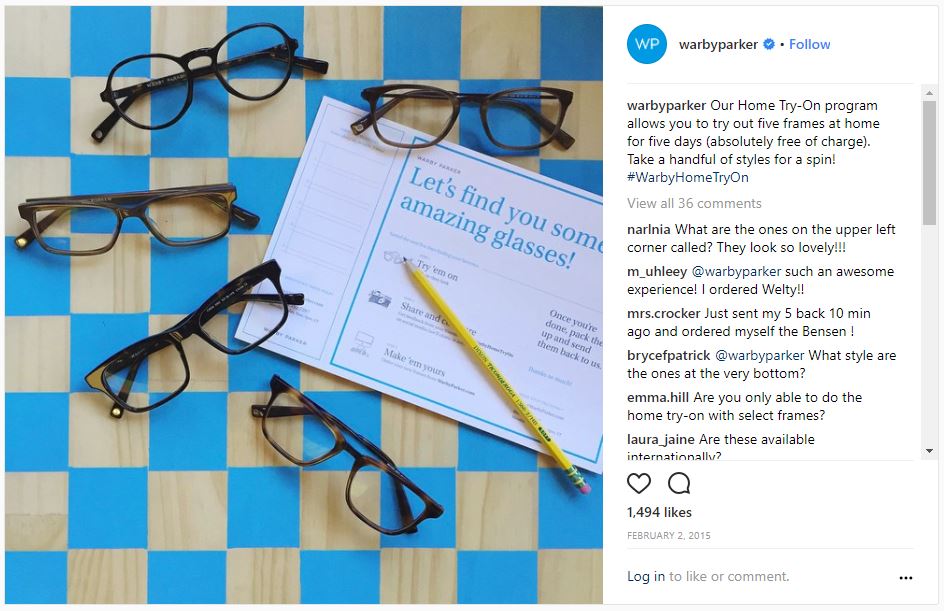
However, changing the public’s perception was only half the fight. Warby Parker also had to grow its audience. The same campaign also helped expand the brand’s community in a way traditional marketing could not. Traditional linear advertising like commercials and radio ads limit how a company can interact with its audience and receive feedback. For Warby Parker, social media offered the best channel of communication. The new company was introducing a new service that revolutionized the industry, and people had questions. The company added a personalized experience to its risk-free offer by asking its audience to post photos of their new eyewear on their social networks. Warby Parker used social media to encourage its audience to talk about the most common inconveniences in the eyewear industry and how the company managed to meet their expectations. User-generated content created authentic experiences which lead to open and honest dialogue between the brand and audience, also known as transactional communication. Unlike linear advertising, social media is the perfect platform for new brands that want to address common concerns, give advice, and suggest solutions. To build your brand online, it is important to engage your audience and create an authentic experience.
The last lesson we can learn from Warby Parker is using a socially conscious business strategy to implement an alternative narrative into your brand. Warby Parker teamed up with VisionSpring to provide free eyeglasses for people in need and has given away over 500,000 pairs.
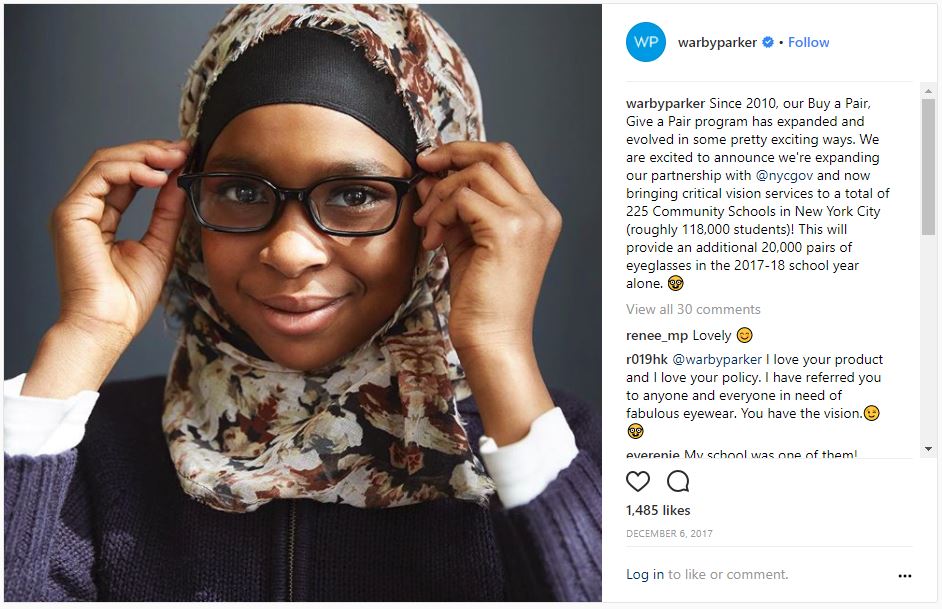
Connecting a brand to a social cause can help expand your social network influence and narrative. Feel-good marketing “is marketing that stimulates a good feeling if you engage with a brand or buy their products” (Goemans, 2017). People like to feel good and need affirmation that their purchases are socially responsible or helping people. Most people seek validation in two ways, externally from the brand or internally from their peers and circle of influence. Warby Parker uses its narrative of compassion to help fortify and supplement its presence on social media. The brand used acts of charity to humanize the company and create opportunities for feel-good marketing. Happy customers making feel-good posts about their socially responsible purchase seek peer validation in likes or shares, which help subsequently increase brand visibility. A humanized brand has more chances of success in the social media world than a robotic corporation. It is important to give your brand an alternative narrative in addition to the marketing message it is conveying.
References
CollegeHumor (2016, September 14). The Conspiracy Behind Your Glasses | Adam Ruins Everything [Video]. https://www.youtube.com/watch?v=h7H-_8UkmFU
Glenson, P. (2019, March 01). What Is Cognitive Dissonance in Marketing?. Chron. https://smallbusiness.chron.com/cognitive-dissonance-marketing-55693.html
Goemans, S. (2017, November 28). The #1 Secret Why Influencer Marketing And Feel Good Marketing Together Are The Holy Grail. Marketing & Growth Hacking. https://blog.markgrowth.com/the-1-secret-why-influencer-marketing-and-feel-good-marketing-together-are-the-holy-grail-719698f6d2ed
Mahoney, L. M., Tang, T. (2016, September 15). Strategic Social Media: From Marketing to Social Change. [[VitalSource Bookshelf version]]. Retrieved from vbk://9781118556900
Warby Parker. 2021. History. https://www.warbyparker.com/history
 Hilda Chang Consulting