

Ring… ring… rign…
“… elloooo?”
“Hey Mom, I am making pupusas for breakfast, just like the ones you make on Sundays”
“Mija they look great. The curtido looks tasty. How are you today?”
“I am ok… Maine has been really rainy today. Some lighting too.”
“ahh… nooo! Don tell me! San Diego is so beautiful right now. I just went yogging. You should come back and live here-”
“Ok, Mom well I got to go… the pupusas are burning. Love you bye.”
“Adios Mija. Te amo. Cuidate.”

The burden of being a first-born Latina daughter falls heavy on my shoulders. I love my mom, but sometimes she does not seem to understand that I moved away for a reason. I found it best to keep video chats short and regular so I am not questioned for my life choices. Although my relationship with my mother is strained, she is one of the only people who helped me connect with my culture. The isolation of the pandemic made me realize I might have been neglecting a key part of myself, and I began exploring my culture by recreating childhood recipes. Unfortunately, my mother does not know the recipes either because all she ever tells me for measurements is a “pinch” of this and a “shake” of that until you know it is right. I did include a recipe link under the photo for those who want to find out exactly what a pupusa is. You might recognize them from Buzzfeed’s Tasty page when Curly and his grandmother made them in an effort to share their culture and heritage.
Facebook has made it very easy for me to retain a relationship with my mother and has become an integral part of my life due to convenience. I primarily use the app to watch silly videos, get the latest news, and maintain a relationship with my loved ones. On the other hand, my mother uses Facebook to converse with family from El Salvador and Utah and runs a small exotic fruit tree business with my father. Facebook has changed over the years as a social media platform and evolved to address the different needs of its audience. It has improved the user experience by listening and altering their platform to fit daily life. What was once a basic communication and feed platform has grown to include live video streaming, a marketplace, groups, events, and so much more. Facebook is a good example of how social media platforms try to address several needs at once to become an important part of a person’s daily activity.
“50.1% of the time spent on mobile was done using social media apps in 2020. Facebook is the most popular, costing people an average of 2 hours and 24 minutes each day.”
(G, 2021)
Facebook captures time by providing users with in-app functions meant to optimize their experience. Although Facebook is the most popular app in America and possibly an integral part of our lives and culture, it does not compare to the Weixin app. Weixin (pronounced way-shin) was originally China’s mainland app but got an international upgrade and became WeChat when it began expanding. WeChat does more for Chinese users than Facebook could ever dream of accomplishing. The video below is from The New York Times and explains why China is the only one with this revolutionary marketing tool.
The app began in 2011 when China banned Facebook and other social media platforms. The New York Times video stated that China was the perfect environment for social media to evolve into its own unique creations. WeChat is not a copy of existing platforms but an amalgam of all social media. Imagine using a single app on your phone to perform all of your daily functions, from money transfers to health care appointments. Today users would be unable to function in China without WeChat because their lives are fully integrated with the technology.
Weixin/ WeChat managed to become the central app of China through the constant and vigilant surveillance of consumer habits and preferences. The app began by creating a user-friendly interface with straightforward and functional designs. As it gained popularity, Weixin began introducing new functions and campaigns in an attempt to satisfy shifting trends, needs, and moods of audience members.
“5 million people participated in the Red Envelope campaign and sent out 20 million cash-filled red envelopes virtually”
(Mahoney et al., 2016)
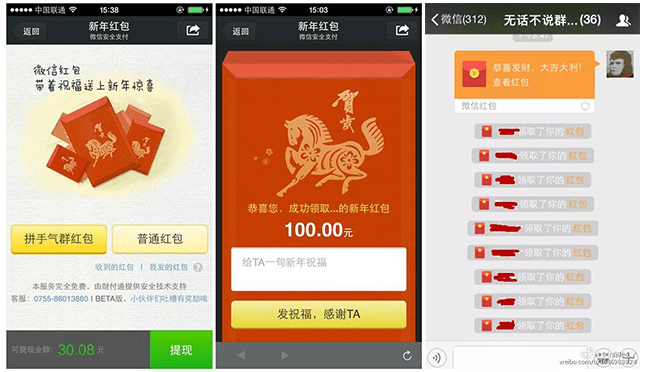
Above is an example of the 2014 “Qiang Hongbao” or Red Envelop campaign Weixein launched in an effort to accommodate the tradition of sending and receiving money for Chinese New Year. This campaign created excitement and anticipation for users making Weixin highly addictive.
Weixin also launched the “Didi Taxi,” which virtually allowed a user to summon a taxi driver in over 30 cities. This feature complimented the Red Envelop campaign by addressing a niche segment and reinforcing the habitual use of Weixin’s wallet feature. Weixin continued adding features to the app, and as more users became comfortable with the new benefits, they became dependent on it to solve everyday needs.
WeChat was able to become an integral part of Chinese life by innovating the app through the perspective of its audience and addressing critical needs. Slow integration of new features ensures that the audience did not have to relearn a new platform and cultivated excitement among the community. Current users were the biggest influencers in the app’s adoption, and the app’s convenience only helped fuel adoption. WeChat is successful because it seamlessly integrated into Chinese life.
Currently, WeChat has more than a billion daily active users and is looking to expand into South America. The app has become so powerful that it has successfully thwarted and stunted the growth of other social media platforms like Sina Weibo, a micro blogging app, and Facebook. Many experts believe Facebook and other social media apps will never be adopted in China due to WeChat’s wide popularity. (Barboza, 2014).
WeChat teaches marketers the importance of knowing their audience. Allen Zhang, a senior executive at Tencent, the company that owns WeChat, explains the reason for WeChat’s success. He states that he asks developers to view WeChat through the eyes of their least sophisticated users and people who are technologically illiterate.
Zhang pushes for a “10/100/1000 Principle” where product managers must do ten end-user interviews, read 100 user blogs, and collect feedback from 1,000 user experiences every month.
(Birkinshaw et al., 2019).
Zhang highlights the importance of selective listening and demonstrates how not all consumer feed should be incorporated into a design. There is no definitive answer to knowing what feedback to ignore, but a consistent theme should be coherence. Asking if the feedback is consistent with the current design and if it can be integrated without interrupting basic functions will help dictate what feedback to incorporate into new strategies.
The key takeaway is that it is necessary to understand the key principles underlying your brand’s chosen approach and development. With every innovation or addition to your brand, you should be asking yourself if it complements your brand. Although innovation is key, it is easy for marketers to diverge from the original strategy and begin falling into a self-centered approach that forgets the customer’s desires. Having a clear understanding of who the audience is will help guide the brand and make new choices and integrations less risky.
References
Barboza, D. (2014, January 20). A Popular Chinese Social Networking App Blazes Its Own Path. The New York Times. https://www.nytimes.com/2014/01/21/technology/a-chinese-social-network-blazes-its-own-path.html
Birkinshaw, J., Liang-Hong Ke, D., & de Diego E. (2019, October 29). The Kind of Creative Thinking That Fueled WeChat’s Success. Harvard Business Review. https://hbr.org/2019/10/the-kind-of-creative-thinking-that-fueled-wechats-success
G. D. (2021, March 29) How Much Time Do People Spend on Social Media in 2021? Tech Jury. https://techjury.net/blog/time-spent-on-social-media/#gref
Mahoney, L. M., & Tang, T. (2016, September 15). Strategic Social Media: From Marketing to Social Change. [[VitalSource Bookshelf version]]. Retrieved from vbk://9781118556900
 Hilda Chang Consulting